
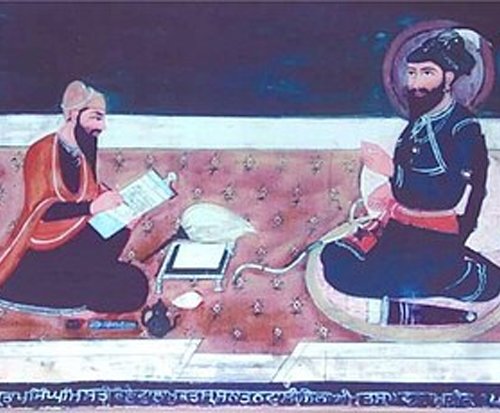
The 1st Mukhi Of Taksal blessed by Guru Gobind Singh Ji.
Shaheed Bhai Mani SIngh Ji – Kalam De Dhani & Brave Warrior Of Guru Gobind Singh Ji
( Scholar • Sevadar • Custodian of Sri Harimandir Sahib • Saint-Soldier • Shaheed )
Name: Mani Ram / Mania ( Bhai Mani Singh Ji)
Birth: 1644, Alipur (Multan–Muzaffargarh, Pakistan)
Father & Mother: Mai Das & Madhari Bai
Brothers: Bhai Jetha Singh Ji, Bhai Dayal Das Ji, Bhai Dan Singh Ji, Bhai Man Singh Ji, Bhai Amar Chand Ji, Bhai Roop Singh Ji, Bhai Jagat Singh Ji, Bhai Sohan Chand Ji, Bhai Lehna Ji, Bhai Rai Singh Ji and Bhai Hati Chand Ji
Wife: Bibi Seeto Ji (Daughter Of Bhai Lakhi Shah Vanjara Ji)
Sons: Bhai Chitar Singh Ji, Bhai Bachittar Singh Ji, Bhai Udai Singh Ji, Bhai Anaik Singh Ji, Bhai Ajab Singh Ji, Bhai Ajaib Singh Ji, Bhai Gurbaksh Singh Ji, Bhai Bhagwan Singh Ji, Bhai Balram Singh Ji and Bhai Desa Singh Ji
Major Role: Scholar, scribe, Granthi, preacher, administrator and custodian of Sri Harimandir Sahib
Shaheedi: 1737 In Lahore, Pakistan.
Served Gurus: Guru Har Rai Ji, Guru Har Krishan Sahib Ji, Guru Tegh Bahadur Sahib Ji and Guru Gobind Singh Ji
Early Life and Family Background
Bhai Mani Singh Ji was born into a deeply devoted Sikh family traditionally associated with Alipur in the Multan region of Punjab, now in Pakistan. His birth is traditionally dated to 1644, and his childhood name is generally given as Mani Ram.
His father was Mai Das Ji, and his mother was Madhari Bai Ji. His grandfather, Rao Ballu Ji, is remembered in Sikh tradition as a brave warrior who served in the time of Guru Hargobind Sahib Ji.
Bhai Mani Singh Ji belonged to a large family. His brothers are remembered in Sikh tradition for their devotion and service to the Guru, and several members of the family later became known for their sacrifice. Among the brothers traditionally associated with his family were Bhai Jetha Singh Ji, Bhai Dayal Das Ji, Bhai Dan Singh Ji, Bhai Man Singh Ji, Bhai Amar Chand Ji, Bhai Roop Singh Ji, Bhai Jagat Singh Ji, Bhai Sohan Chand Ji, Bhai Lehna Ji, Bhai Rai Singh Ji and Bhai Hati Chand Ji.
His brother Bhai Dayal Das Ji holds a particularly honoured place in Sikh history. He accompanied Guru Tegh Bahadur Sahib Ji to Delhi and attained martyrdom alongside the Guru in 1675.
Bhai Mani Singh Ji’s family therefore became closely connected with the Sikh tradition of seva, bravery and sacrifice.
Childhood in the Guru’s Presence
At a young age, Bhai Mani Singh Ji came into the presence of the Guru’s household. He became closely associated with Guru Tegh Bahadur Sahib Ji and the young Gobind Rai, who would later become Guru Gobind Singh Ji.
Although Bhai Mani Singh Ji was older than Gobind Rai, the two developed a close relationship during their years together.
This relationship became one of the defining features of Bhai Mani Singh Ji’s life.
He did not merely spend time in the Guru’s company; he grew spiritually and intellectually within the environment of the Guru’s household. He learned the discipline of seva, developed a deep understanding of Gurbani and became increasingly devoted to the Sikh way of life.
His association with the Guru’s household would eventually continue for decades.
Association With Four Sikh Gurus
Bhai Mani Singh Ji holds the rare distinction of having lived through the period of four Sikh Gurus.
He was associated with:
- Guru Har Rai Ji: His early connection with the Sikh tradition developed during the period of Guru Har Rai Ji. Traditional accounts describe him receiving Sikh learning and becoming familiar with the discipline of seva and Gurbani.
- Guru Har Krishan Sahib Ji: He continued his association with the Guru’s household during the brief Guruship of Guru Har Krishan Sahib Ji.
- Guru Tegh Bahadur Sahib Ji : During the period of Guru Tegh Bahadur Sahib Ji, his development as a learned Sikh became more pronounced. He became associated with Gurbani study, Sikh teaching and the preparation of handwritten scripture.
- Guru Gobind Singh Ji: His relationship with Guru Gobind Singh Ji was the most significant. Their childhood association developed into a lifelong bond of service. Bhai Mani Singh Ji remained connected with Guru Gobind Singh Ji through the creation of the Khalsa and the major events of the Guru’s later life.
His relationship with Guru Gobind Singh Ji was especially close and remained one of lifelong devotion.
Through these successive Guruships, Bhai Mani Singh Ji witnessed a tremendous transformation in Sikh history — from the peaceful propagation of Gurbani and Gurmat to the formation of the Khalsa and the struggle for religious freedom and righteousness.
Marriage and Family Life
Bhai Mani Singh Ji was married in his youth to Bibi Seeto Ji, traditionally remembered as the daughter of Bhai Lakhi Rai Ji.
His family became closely associated with the service of the Guru and the Khalsa.
Several of his sons became renowned for their courage and sacrifice. Among those traditionally remembered are Bhai Bachittar Singh Ji, Bhai Udai Singh Ji, Bhai Anaik Singh Ji, Bhai Ajab Singh Ji, Bhai Ajaib Singh Ji, Bhai Chitar Singh Ji and Bhai Gurbaksh Singh Ji.
The lives of his sons demonstrate that the principles of courage and sacrifice were not merely teachings that Bhai Mani Singh Ji preached to others. They were values lived within his own family.
Learning Gurbani and Sikh Vidya
Bhai Mani Singh Ji became one of the learned Sikhs of his generation.
He devoted himself to the study of Gurbani, Sikh philosophy, scripture and religious literature. He developed exceptional skill as a scribe and became known for carefully preparing handwritten copies of sacred Sikh texts.
His association with Guru Gobind Singh Ji provided him with an opportunity to deepen his understanding of Gurbani and Gurmat.
He was not simply a person who could read and write scripture. He was also a teacher and interpreter who helped Sikhs understand the teachings contained within Gurbani.
His life therefore became a meeting point between Vidya and Seva.
Service With Guru Gobind Singh Ji
Bhai Mani Singh Ji remained closely associated with Guru Gobind Singh Ji as the Guru’s responsibilities expanded.
He accompanied the Guru during important periods of his life and became a trusted member of the Guru’s household.
During the period at Paonta Sahib, where Guru Gobind Singh Ji spent significant time in literary and spiritual activity, Bhai Mani Singh Ji further developed his knowledge and skills as a scribe.
He became closely involved with the preservation and preparation of Sikh literature.
Alongside his intellectual abilities, he was also trained in martial discipline and remained prepared to serve the Guru whenever required.
This combination of scholarship and courage became a defining characteristic of his personality.
Bhai Mani Singh Ji as a Warrior
Although Bhai Mani Singh Ji is primarily remembered as a scholar and martyr, he was also a courageous Sikh who understood the responsibility of defending righteousness.
He was associated with the Guru’s military campaigns and is traditionally remembered for displaying great courage in battles including Bhangani and Nadaun.
His role in the Sikh community therefore reflected the principle later strongly embodied by the Khalsa:
A Sikh must possess both spiritual wisdom and the courage to stand against injustice.
His sword and his pen were both placed in the service of the Guru.
The Battle of Nadaun
The Battle of Nadaun became an important episode in the military history of Guru Gobind Singh Ji.
Bhai Mani Singh Ji participated in the conflict and demonstrated considerable courage.
Following the victory, his abilities and loyalty were further recognised, and he was entrusted with greater responsibilities within the Guru’s administration.
His growing role showed that he was valued not only for his martial ability but also for his wisdom, organisational skills and understanding of Sikh affairs.
The Creation of the Khalsa – 1699
The year 1699 changed the course of Sikh history.
On the sacred day of Vaisakhi at Anandpur Sahib, Guru Gobind Singh Ji established the Khalsa Panth.
The Khalsa was established upon the principles of equality, discipline, devotion, courage and complete commitment to the Guru.
Bhai Mani Singh Ji received Khande di Pahul from Guru Gobind Singh Ji and became part of the Khalsa discipline.
From this point onward, his life became even more closely connected with the organised Khalsa Panth.
Several members of his family also entered the Khalsa fold, further strengthening the family’s commitment to the Guru’s path.
Seva at Sri Harimandir Sahib
After the establishment of the Khalsa, Guru Gobind Singh Ji entrusted Bhai Mani Singh Ji with a major responsibility at Amritsar.
He was sent to take charge of Sri Harimandir Sahib and the associated Sikh institutions.
This was one of the most important responsibilities that could be entrusted to a Sikh.
Sri Harimandir Sahib was the spiritual centre of the Sikh Panth, and its proper functioning required someone who possessed not only religious knowledge but also organisational ability, discipline and complete loyalty to the Guru.
Bhai Mani Singh Ji accepted this responsibility as seva.
Bhai Mani Singh Ji at Amritsar
At Amritsar, Bhai Mani Singh Ji worked to restore and strengthen Sikh religious life.
He encouraged the regular recitation of Gurbani, Kirtan, Katha and the teaching of Gurmat.
He also helped organise the Sikh community and encouraged people to adopt the discipline of the Khalsa.
His presence transformed Amritsar into an important centre of Sikh learning and religious activity.
He became known for his ability to explain Gurbani clearly to the Sangat.
His daily life was therefore centred around:
Gurbani, Kirtan, Katha, Seva and Sangat.
Bhai Mani Singh Ji as Granthi and Teacher
Bhai Mani Singh Ji became one of the most respected Granthis and religious teachers associated with Sri Harimandir Sahib.
He was deeply knowledgeable in Gurbani and was capable of explaining its spiritual meaning to the Sangat.
His Katha attracted Sikhs who came to Amritsar to learn about the teachings of the Gurus.
Through his teaching, he helped strengthen the tradition of Sikh learning that later became associated with the Giani tradition.
His influence extended far beyond Amritsar because Sikhs who learned from him carried Gurmat teachings back to their own communities.
Preservation of Sikh Scripture
One of Bhai Mani Singh Ji’s greatest contributions was his service to the written tradition of Sikh scripture.
He was an accomplished scribe and prepared handwritten copies of sacred texts.
When Guru Gobind Singh Ji was at Talwandi Sabo, Bhai Mani Singh Ji joined him and assisted in the preparation of the final recension of Sri Guru Granth Sahib Ji.
He carefully transcribed the scripture under the Guru’s supervision.
This was an enormous responsibility.
The Sikh community depended upon accurate preservation and transmission of Gurbani, and the work of skilled scribes such as Bhai Mani Singh Ji helped ensure that the sacred scripture could be carried forward to future generations.
His contribution in this field is one of the reasons he is remembered as one of the great Sikh scholars and scribes.
The Difficult Days at Anandpur Sahib
During the final period at Anandpur Sahib, the Sikh community faced a prolonged siege.
The situation eventually became extremely difficult, and Guru Gobind Singh Ji and the Sikhs had to leave Anandpur Sahib.
During this turbulent period, Bhai Mani Singh Ji was entrusted with important responsibilities involving members of the Guru’s household.
He helped ensure the safety of Mata Sundari Ji and Mata Sahib Kaur Ji during the difficult journey that followed the evacuation.
His service during this period once again demonstrated the trust placed in him by the Guru’s household.
Starting Of Taksal By Guru Ji In Talwandi Sabo – Damdami Sahib
Talwandi Sabo became an important centre of Sikh learning during the later period of Guru Gobind Singh Ji’s life.
When Sri Dasham Patshah Ji, having become free from wars and battles, opened his loins, then at Talwandi Sabo, Sri Guru Granth Sahib Ji was composed based on his experience. Read the special research about Samvat in the first volume of this book] And to understand its meaning, the Satguru himself first began the story, which Bhai Sahib Bhai Mani Singh Ji was a special person among the 48 lovers who listened to it.
There were 48 Sikh devotees who attained liberation from the body by listening to the story, but the Satguru had to establish a mint of the meanings of Gurbani for the future tradition. According to this wish, out of the 48 listeners, out of their immense grace, Sri Maan Bhai Mani Singh Ji and Sri Maan Baba Deep Singh Ji, who had attained liberation from the body, bestowed the blessing of never forgetting joy and entrusted Baba Deep Singh with the service of Sri Damdame Sahib Ji. Among their great service, this special service is famous that they wrote the four Birs of Sri Guru Granth Sahib Ji with their kar-kamals and installed them on the four Takht Sahibs, which became famous as the Damdami Bir. They are the ones who attained martyrdom for the sake of maintaining the service of Sri Harmandir Sahib, Amritsar. From their ancestral lineage, today, Sri Maan Gyani Gurbachan Singh Ji is doing great service of preaching Gurbani with ‘Khalsa’ Bhindran Wale.*
Sri Mann Bhai Mani Singh Ji was given the service of running the Taksal of Sri Amritsar, and as per the order of Dasam Pita Ji, he continued to perform the service of the Head Granthi of Sri Harmandir Sahib Ji and at the same time started the Katha, which continued to be enjoyed every year by the Katha of Sri Guru Granth Sahib Ji. Among these, the chief among them was Bhai Diwan Singh Ji, who took over the service of the Katha after the martyrdom of Sri Mann Bhai Mani Singh Ji and the great secret meaning that Sri Mann Bhai Mani Singh Ji had heard from Sri Dasam Patshah Ji, the same great secret meaning that Sri Mann Bhai Diwan Singh Ji kept on expressing to the Sangat. After them, Bhai Gurdial Singh Ji and Bhai Gurbaksh Singh Ji, Bhai Ram Singh Ji who was inherited from Bhai Amar Singh Ji, after him, the famous scholar of the Panth Shri Mann Gyani Chanda Singh Ji (Karta Prayay), Daya Singh Ji, before them, Shri Mann Sant Bhagwan Singh Ji continued to run this sectarian Taksal with great devotion. Before them, Shri Mann Brahm Bete Sant Gyani Amir Singh Ji continued to do the great and excellent service of this divine knowledge.
Service After Guru Gobind Singh Ji
After Guru Gobind Singh Ji’s departure from this world in 1708, Bhai Mani Singh Ji continued his service to the Sikh Panth.
The Guru had entrusted the Sikhs with the eternal spiritual authority of Guru Granth Sahib Ji and the Guru Khalsa Panth.
The period that followed was extremely difficult.
Sikhs faced political persecution, military pressure and restrictions on their religious gatherings.
Bhai Mani Singh Ji continued to maintain Sikh institutions and guide the Sangat.
He became one of the important religious figures who helped preserve Sikh identity during these difficult years.
Leadership at Amritsar
hai Mani Singh Ji’s role at Amritsar became increasingly important.
He maintained the religious traditions of Sri Harimandir Sahib and encouraged Sikhs to remain connected with Gurbani and the teachings of the Gurus.
He also organised major Sikh gatherings at Amritsar.
These gatherings were important because they allowed Sikhs from different regions to meet, worship together, discuss Panthic affairs and strengthen their collective identity.
Bhai Mani Singh Ji understood that the survival of the Sikh Panth required not only warriors in the field but also strong religious institutions and united Sangats.
Bringing Unity to the Sikh Panth
After the martyrdom of Banda Singh Bahadur and his companions, serious differences developed within the Sikh community.
The division between the Bandai Sikhs and Tat Khalsa created the possibility of conflict within the Panth.
Bhai Mani Singh Ji played an important role in resolving this dispute.
Through wisdom, dialogue and his respected position among the Sikhs, he helped restore unity.
This episode is extremely important in understanding his character.
Bhai Mani Singh Ji was not interested merely in personal glory.
His priority was the unity and welfare of the Panth.
Bhai Mani Singh Ji as a Scholar and Writer
Bhai Mani Singh Ji is traditionally associated with important Sikh literary works, particularly Gian Ratnavali and Bhagat Ratnavali.
These works became significant within the tradition of Sikh religious learning and helped explain Sikh teachings and the lives and qualities of devoted Sikhs.
His literary legacy is closely connected with his broader role as a scholar, teacher and preserver of Sikh knowledge.
He believed that the Panth could remain strong only when Sikhs remained connected to Gurbani and Gurmat.
The Persecution of the Sikhs
The eighteenth century brought severe persecution upon the Sikh community.
The Mughal authorities attempted to suppress Sikh gatherings and prevent the Sikhs from establishing a strong collective presence.
Sikhs were forced to live under constant threat.
Despite these circumstances, Bhai Mani Singh Ji continued his service at Amritsar.
He refused to allow fear to destroy Sikh religious life.
He continued to encourage Sikhs to remain connected with Sri Harimandir Sahib and the Guru’s teachings.
The Diwali Gathering at Amritsar
One of the final and most important episodes of Bhai Mani Singh Ji’s life was connected with the Diwali gathering at Amritsar.
Bhai Mani Singh Ji sought permission for Sikhs to gather at Sri Harimandir Sahib.
Permission was granted on the condition that a substantial amount of money would be paid to the authorities.
The Sikh community traditionally gathered in large numbers at Amritsar during important occasions, and Bhai Mani Singh Ji expected that the offerings from the Sangat would enable the required payment to be made.
However, the authorities had another intention.
A military force was prepared to attack the Sikhs when they gathered.
When Bhai Mani Singh Ji learned about the planned attack, he warned the Sikhs and prevented a large gathering from taking place.
As a result, the expected offerings were not collected and the required payment could not be made.
The authorities then used the unpaid amount as a pretext to take action against Bhai Mani Singh Ji.
His decision saved the lives of countless Sikhs.
He chose the safety of the Sangat over his own life.
Arrest of Bhai Mani Singh Ji
Bhai Mani Singh Ji was arrested and taken to Lahore.
He was brought before the authorities and subjected to severe pressure.
He was asked to abandon the Sikh faith.
But the man who had spent his entire life serving the Guru could not be separated from the Guru’s path.
He refused to surrender his faith.
His years of scholarship, seva and spiritual discipline had prepared him for this final test.
The Supreme Sacrifice
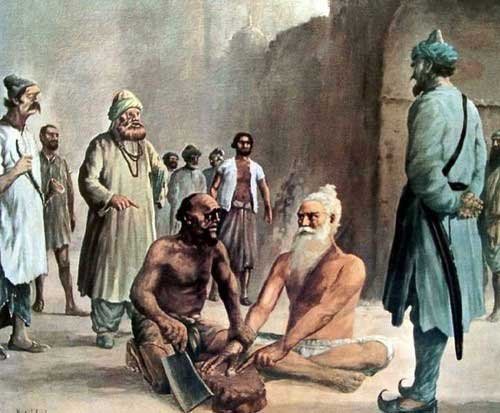
Bhai Mani Singh Ji was sentenced to death. The punishment ordered against him was one of the most brutal forms of execution: his body was to be cut apart joint by joint. The purpose was to break his spirit through extreme physical suffering. But Bhai Mani Singh Ji remained steadfast.
He accepted the pain but refused to abandon Sikhi. His martyrdom became one of the most powerful examples of Sikh steadfastness and faith. He gave his body, but he did not surrender his principles.
Martyrdom at Lahore
Bhai Mani Singh Ji attained martyrdom at Lahore, becoming one of the most revered Shaheeds of the eighteenth-century Sikh Panth. His martyrdom is remembered as the culmination of a life dedicated to:
Guru • Gurbani • Panth • Seva • Sikhi
The place associated with his martyrdom became known as Shaheed Ganj Bhai Mani Singh Ji. The memory of his sacrifice remains deeply connected with Lahore and with the history of the Sikh community in Punjab.
His Greatest Qualities
Bhai Mani Singh Ji’s life can be understood through several qualities.
Vidya — Knowledge
He devoted himself to Gurbani and Sikh learning.
Seva — Selfless Service
He served the Guru and the Sangat without seeking personal reward.
Dharam — Righteousness
He remained committed to the principles taught by the Gurus.
Ekta — Unity
He worked to prevent divisions within the Sikh Panth.
Nirbhau — Fearlessness
He remained fearless even when faced with persecution and death.
Shaheedi — Sacrifice
He accepted the ultimate sacrifice rather than surrender his faith.
The Legacy of Shaheed Bhai Mani Singh Ji
Bhai Mani Singh Ji’s legacy is much greater than the story of his martyrdom.
He was a scholar who preserved Gurbani.
He was a teacher who spread Gurmat.
He was a scribe who served the written tradition of Sikh scripture.
He was a Granthi who served Sri Harimandir Sahib.
He was a leader who worked for Panthic unity.
He was a trusted Sikh of Guru Gobind Singh Ji.
And he was ultimately a Shaheed who refused to compromise his faith.
His life demonstrates the complete Sikh ideal: learn the Guru’s teachings, live according to them, serve humanity, stand with righteousness and remain fearless when tested.
Shaheed Bhai Mani Singh Ji remains an eternal inspiration for every Sikh who seeks to live according to Gurbani, serve the Panth and remain steadfast in the face of adversity.